
Yes. I’d make the links contextual throughout the article, not just dump links at the bottom. I also checked the live VPS site so we can point readers to real existing resources. (Vacuum Pump Supply)
Here is the rewritten version ready for BigCommerce. I’m using clickable VPS links in the copy.
Vacuum Pump Not Pulling Full Vacuum? 10 Common Causes and What to Check First
When a vacuum pump suddenly stops reaching its normal vacuum level, it doesn't necessarily mean the pump needs to be rebuilt.
In many cases, the problem is something much simpler: contaminated oil, a leaking fitting, a clogged filter, an incorrect valve position, or another issue that can be identified before the pump ever comes apart.
Before ordering parts—or taking a pump out of service—work through these common causes.
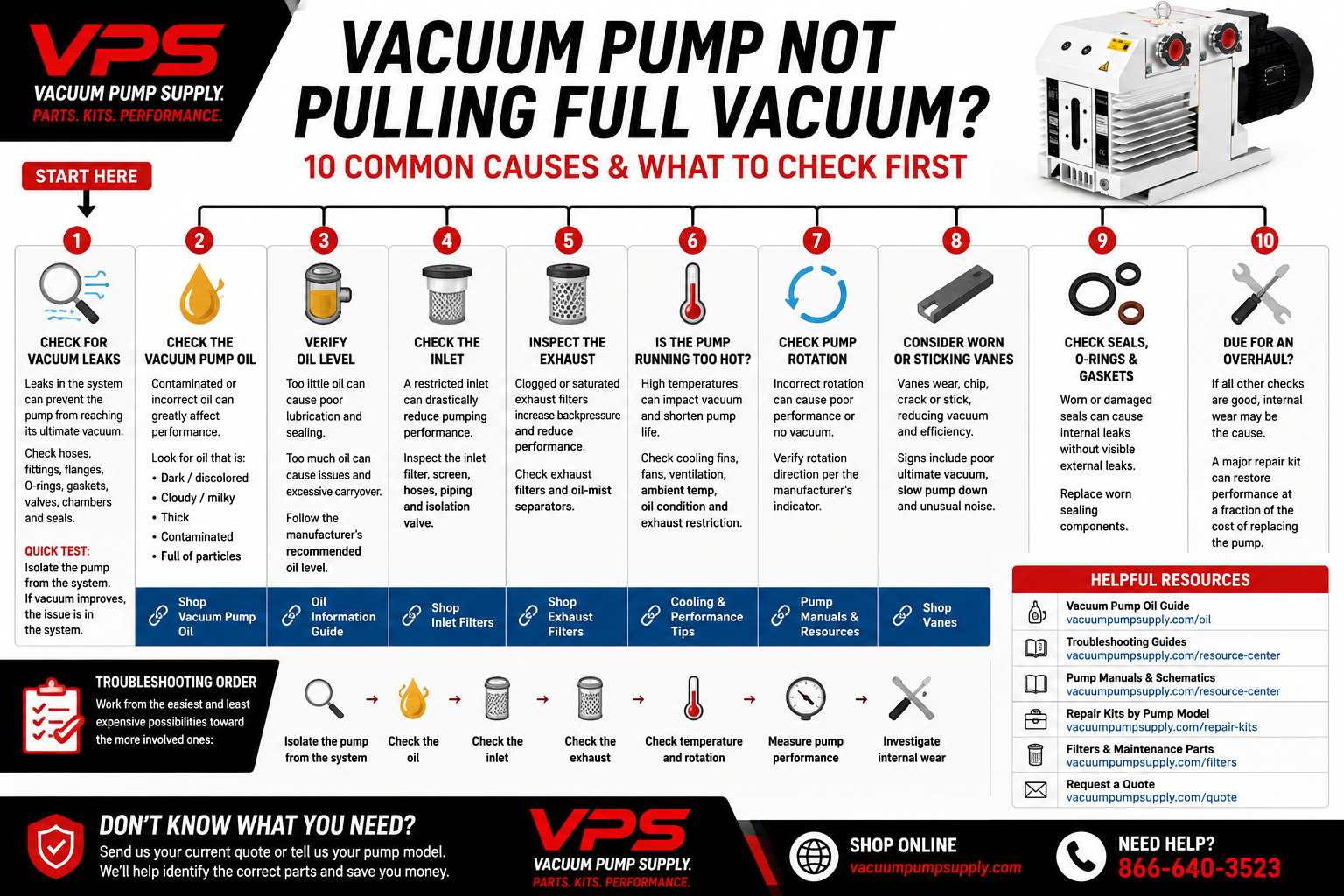
1. Check for Vacuum Leaks First
Before blaming the pump, make sure the vacuum system itself is tight.
Leaks can occur at:
-
Hose and tubing connections
-
Flanges and fittings
-
O-rings and gaskets
-
Valves
-
Vacuum chamber seals
-
Feedthroughs and instrumentation connections
A relatively small leak can prevent an otherwise healthy vacuum pump from reaching its normal ultimate pressure.
Quick test: If possible, isolate the pump from the vacuum system and measure vacuum directly at the pump inlet. If the pump performs normally when isolated, the problem is likely somewhere in the system rather than inside the pump.
That simple test can save a lot of unnecessary troubleshooting.
2. Look at the Vacuum Pump Oil
For an oil-sealed rotary vane pump, the condition of the oil can have a major effect on performance.
Look through the sight glass.
Healthy vacuum pump oil is generally clear and relatively clean. Depending on the application and oil type, warning signs can include oil that is:
-
Dark or heavily discolored
-
Cloudy or milky
-
Thick
-
Contaminated with process material
-
Full of visible particles
-
Unusually low or high in the sight glass
Milky oil can indicate moisture contamination, while dark oil can indicate contamination, overheating, oxidation, or extended service.
If there is any doubt about the condition of the oil, an oil change is one of the simplest places to begin.
Important: Always use the correct oil for the pump and application. Oil viscosity, vapor pressure, chemistry, and process compatibility can all affect performance.
Need help identifying the correct oil? Use the Vacuum Pump Oil Cross Reference Chart to compare common OEM oils with VPS equivalents.
3. Verify the Oil Level
Even clean oil won't help if the level is incorrect.
Check the manufacturer's recommended oil level with the pump in the specified operating condition.
Too little oil can affect lubrication and sealing.
Too much oil can also create operating problems and may contribute to excessive oil carryover.
Don't simply fill the reservoir to the top of the sight glass. Follow the level specified for your particular pump.
If you don't have the manual, check the Resources section on Vacuum Pump Supply. Our site includes schematics, manuals, parts diagrams, cross-reference information and manufacturer-specific Resource Centers. (Vacuum Pump Supply)
4. Check the Inlet and Inlet Filter
A restricted inlet can dramatically reduce pumping performance.
Inspect the:
-
Inlet filter
-
Inlet screen
-
Vacuum hose
-
Piping
-
Isolation valve
-
Inlet connection
Filters can become loaded with dust, process material, oil, or other contaminants.
Also check flexible vacuum hose. A hose can look perfectly normal externally while collapsing internally under vacuum.
If the pump reaches good vacuum but takes significantly longer than it used to, an inlet restriction should be on your troubleshooting list.
5. Inspect the Exhaust System
People naturally look at the inlet side of a vacuum pump when performance drops, but don't forget the exhaust.
A clogged or saturated exhaust filter can increase backpressure and affect pump operation.
Common symptoms can include:
-
Excessive oil mist
-
Increased operating temperature
-
Reduced pumping performance
-
Higher motor load
-
Oil leaks
-
Unusual exhaust noise
If your pump uses replaceable exhaust filters or oil-mist separators, inspect them according to the manufacturer's recommended maintenance schedule.
6. Is the Pump Running Too Hot?
Vacuum pumps generate heat during normal operation, but excessive temperature can be a warning sign.
Check for:
-
Blocked cooling fins
-
Dirty cooling surfaces
-
Failed cooling fans
-
Poor ventilation around the pump
-
High ambient temperature
-
Incorrect oil
-
Low oil level
-
Exhaust restriction
Temperature and vacuum performance can be related.
A pump that consistently operates above its intended temperature range can experience accelerated oil degradation, seal deterioration and premature wear.
7. Check Pump Rotation
This one is easy to overlook—particularly after electrical work, motor replacement or moving equipment.
Some vacuum pumps can run while rotating in the wrong direction but will not pump correctly.
If the problem started immediately after electrical work, verify motor rotation against the manufacturer's direction-of-rotation indicator before doing anything more invasive.
8. Consider Worn or Sticking Vanes
Rotary vane pumps depend on the vanes maintaining contact with the pump chamber to create the compression stages required for vacuum.
Over time, vanes can:
-
Wear
-
Chip
-
Crack
-
Become contaminated
-
Stick in their rotor slots
Symptoms of vane problems can include:
-
Poor ultimate vacuum
-
Reduced pumping speed
-
Difficulty starting
-
Unusual noise
-
Performance that deteriorates as the pump ages
If the oil, filters, system plumbing and external components check out, internal vane condition becomes increasingly important.
This is where a minor repair kit, vane kit or major repair kit may become necessary.
9. Worn Seals, O-Rings and Gaskets
A vacuum pump contains numerous sealing points.
As seals age, they can harden, flatten, crack or lose elasticity.
A seal doesn't necessarily have to produce a visible external oil leak to affect vacuum performance. An internal air leak can reduce ultimate vacuum without leaving an obvious external clue.
This is one reason comprehensive major repair kits contain much more than just vanes.
Depending on the pump, a major repair kit may include:
-
Vanes
-
Shaft seals
-
O-rings
-
Gaskets
-
Valve components
-
Springs
-
Washers
-
Bearings
-
Other common wear components
Replacing the appropriate wear components during an overhaul helps restore the sealing and mechanical condition of the pump.
Vacuum Pump Supply carries both OEM and OEM-equivalent repair solutions across many major vacuum pump manufacturers.
10. The Pump May Simply Be Due for an Overhaul
Vacuum pumps are mechanical equipment.
After enough operating hours, even a properly maintained pump will experience wear.
If you've checked:
✓ System leaks
✓ Oil condition
✓ Oil level
✓ Inlet restrictions
✓ Exhaust restrictions
✓ Operating temperature
✓ Rotation
✓ External components
…and the pump still won't reach its expected vacuum, it may be time to investigate internal wear.
The good news is that many industrial rotary vane vacuum pumps are designed to be rebuilt rather than replaced.
A properly selected repair kit can often return a serviceable pump to reliable operation at a fraction of the cost of replacing the entire pump.
A Simple Vacuum Pump Troubleshooting Order
When a pump isn't reaching vacuum, don't start by taking it apart.
Work from the easiest and least expensive possibilities toward the more involved ones:
1. Isolate the pump from the system.
Determine whether the problem is actually the pump.
2. Check the oil.
Check condition, type and level.
3. Check the inlet.
Look for restrictions and leaks.
4. Check the exhaust.
Inspect filters and look for excessive backpressure.
5. Check temperature and rotation.
6. Measure pump performance directly.
7. Only then investigate internal wear.
Following a logical troubleshooting sequence can prevent unnecessary parts replacement and significantly shorten troubleshooting time.
Find Parts and Technical Information for Your Pump
One of the biggest projects underway at Vacuum Pump Supply is expanding our online technical resources so customers can find more than just a part number.
Our growing Vacuum Pump Resource Centers provide access to repair kits, maintenance information, parts, manuals, schematics and other technical resources for many of the industry's most widely used vacuum pumps.
Current resources cover manufacturers and pump families including Edwards, Leybold, Busch, Welch, Becker, Rietschle and Alcatel/Adixen. (Vacuum Pump Supply)
These resources can help you go from:
Pump problem → pump model → technical information → correct replacement part
without having to search through multiple websites.
Don't Know Which Repair Kit or Part You Need?
That's where Vacuum Pump Supply can help.
Since 2006, we've helped laboratories, manufacturers, service companies, universities and maintenance departments identify replacement parts for industrial vacuum pumps.
We carry thousands of products for major manufacturers including:
-
Edwards
-
Leybold
-
Busch
-
Welch
-
Becker
-
Alcatel/Adixen
-
Stokes
-
Rietschle
-
And others
Our selection includes repair kits, vacuum pump oil, vanes, shaft seals, O-rings and gaskets, inlet filters, exhaust filters and replacement parts.
If you know the pump manufacturer and model, start with the Resource Centers or site navigation.
If you know the part number, search it directly.
And if you're not sure what you need, contact Vacuum Pump Supply or request a quote and tell us what pump you're working on. Our team can help identify the correct parts.
Keep Your Vacuum Pumps Running—and Your Maintenance Costs Under Control
A vacuum pump that won't reach full vacuum doesn't automatically need replacement.
Start with the basics. Find the cause. Fix what actually needs fixing.
And when parts are required, compare your options before automatically paying OEM prices.
Vacuum Pump Supply
866-640-3523
Parts. Kits. Performance.
Related Vacuum Pump Resources
Vacuum Pump Oil Cross Reference Chart — Find OEM vacuum pump oil equivalents and VPS replacement options by manufacturer, viscosity, oil type and application.
Vacuum Pump Resource Centers — Access manufacturer-specific repair information, schematics, manuals, repair kits, oil recommendations and replacement parts through the Resources menu. (Vacuum Pump Supply)
Contact Us / Request a Quote — Send VPS your pump model or part number if you need help identifying the correct product.